




Product Summary:
Capacitive displacement sensors convert the physical displacement to be measured (distance change) into a change in the capacitance of a capacitor, and then convert the capacitance change into a standard electrical signal (such as voltage, current or frequency) output through a measurement circuit, thereby calculating the current displacement. The two flat electrodes are respectively represented by the sensor and the corresponding measurement object. If a constant alternating current flows through a capacitive sensor, the amplitude change of the alternating voltage passing through the sensor is proportional to the distance between the capacitive plates. By using the capacitor formed between the probe and the conductive target, the physical distance change between the two is converted into a change in capacitance. Then, through a precise electronic circuit, this change is detected and linearized, and finally a standard signal proportional to the distance is output.
- Product Overview
- Technical Parameters
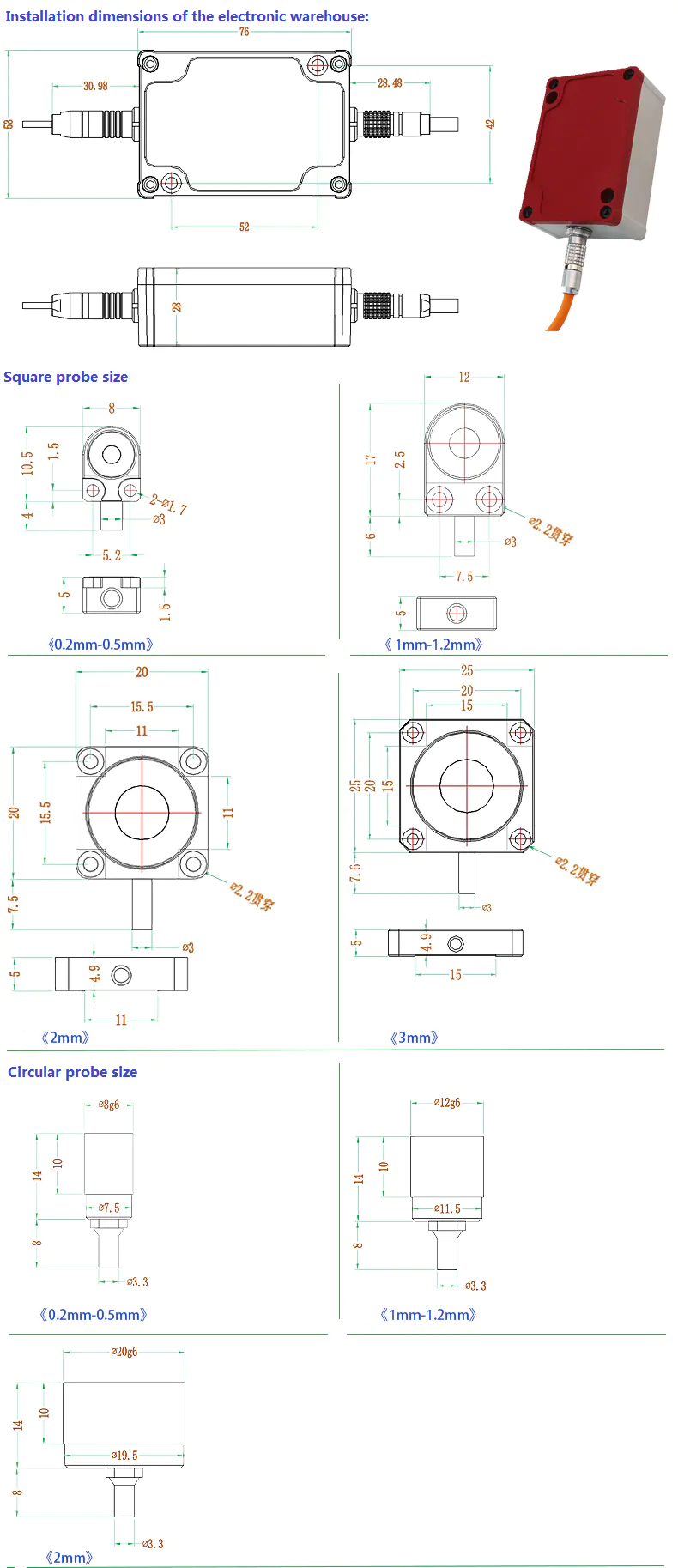
- Size selection
I. Overview of Capacitive Displacement Sensors
Capacitive displacement sensors convert the physical displacement to be measured (distance change) into a change in the capacitance of a capacitor, and then convert the capacitance change into a standard electrical signal (such as voltage, current or frequency) output through a measurement circuit, thereby calculating the current displacement. The two flat electrodes are respectively represented by the sensor and the corresponding measurement object. If a constant alternating current flows through a capacitive sensor, the amplitude change of the alternating voltage passing through the sensor is proportional to the distance between the capacitive plates. By using the capacitor formed between the probe and the conductive target, the physical distance change between the two is converted into a change in capacitance. Then, through a precise electronic circuit, this change is detected and linearized, and finally a standard signal proportional to the distance is output.
Alternating current is demodulated and output as an analog signal. The sensor can measure all conductive materials and is mainly used for displacement, position and thickness measurement.
Variable pitch type: The object to be measured serves as one electrode (or is connected to one electrode), and the sensor probe acts as the other fixed electrode. When there is a slight change in distance, the capacitance changes significantly (in a nonlinear inverse proportion relationship). The displacement can be calculated by detecting the change in capacitance through the measurement circuit. It is suitable for small displacement and high-precision measurement.
II. Characteristics and Applications of Capacitive Displacement Sensors
Youdaoplaceholder0 Non-wear and non-contact measurement, distance and thickness measurement of conductive and non-conductive objects
It features high resolution, high precision, high stability, high reliability, fast response time and long working life.
Youdaoplaceholder0 is applied in industries such as industrial automation and precision measurement .
III.Technical Parameter:
Supply voltage: DC12-24V
The linearity can reach: 0.1μm
Repeatability as high as: 0.0003% FS
Long-term stability: ± 0.002% FS
Temperature stability: 5ppm
The measurement range is from 0.05mm to 10mm (expandable
Signal output: RS485, 0-5V, 0-10V, ±5V, ±10V, 4-20mA
The maximum resolution can reach: 0.0375nm (temperature range: -270 ℃ to +200 ℃)
IV. Application Fields of Capacitive Displacement Sensors
● Precision Manufacturing and quality Inspection:Real-time health monitoring of blade deformation and vibration;
V. Features of Capacitive Displacement Sensors
★ Non-contact measurement: Avoid causing damage or interference to the object being measured
★ Measurement of distance and thickness of conductive and non-conductive objects
★ High precision and stability, with a resolution reaching the nanometer level
★ High-frequency response: Suitable for dynamic vibration measurement
★ Suitable for industrial environments, electromagnetic fields and vacuum environments
★ Material sensitivity: The conductivity of the object being tested, environmental temperature and humidity, and electric field interference need to be taken into consideration
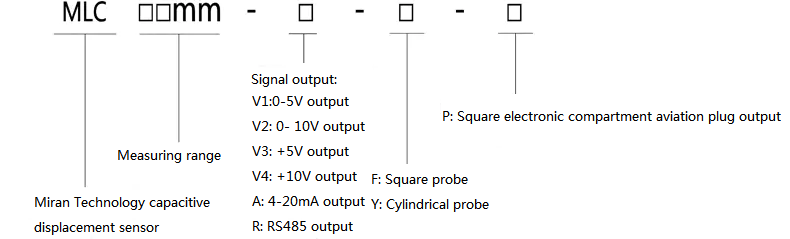
VI. Model Selection
VII. Installation Dimensions of Capacitive Displacement Sensor