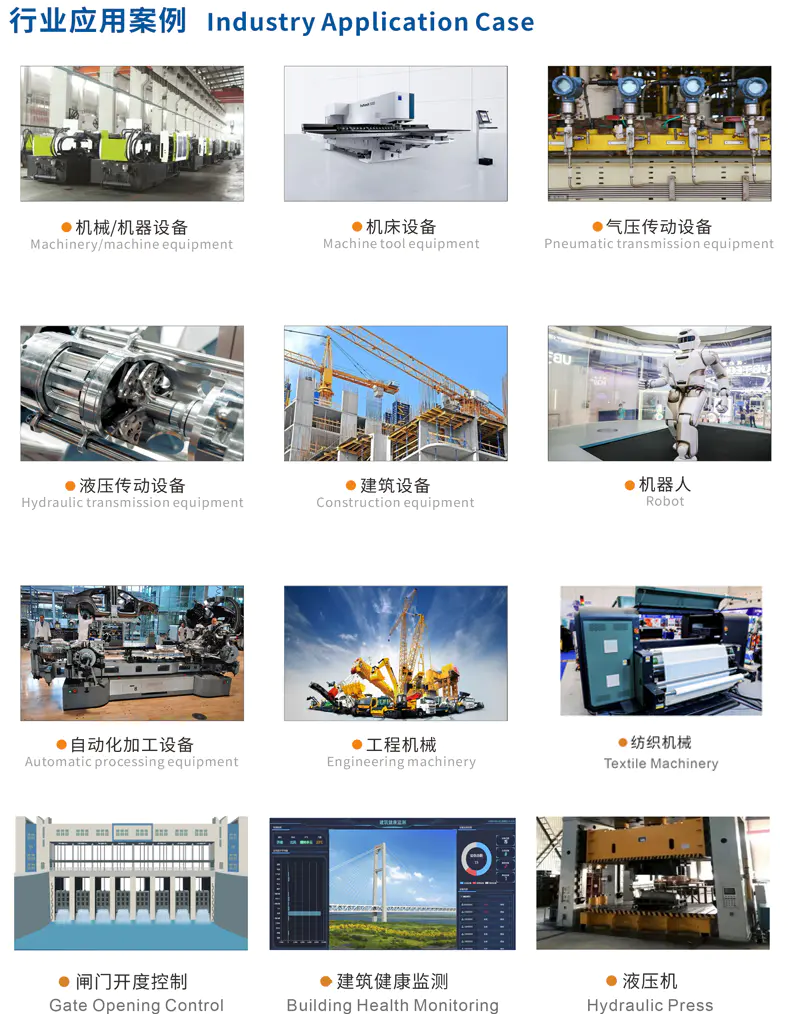




Automated equipment is not merely a tool; it is the core engine driving the leap of human industrial civilization from the "steam Age" to the "intelligent age". Its role is not only reflected in the improvement of production efficiency but also profoundly influences industrial structure, economic models, and even social development.
The development trends of automated equipment include improving precision, efficiency, and intelligence. Therefore, displacement sensors, as core sensing components in automated mechanical equipment, play a crucial role and are of vital importance in equipment upgrades and intelligent development.
1. Enhance equipment accuracy and stability: Displacement sensors detect the displacement of mechanical moving parts in real time, ensuring the equipment's repeat positioning accuracy at the micrometer level or higher. By providing real-time feedback on displacement data, they automatically compensate for mechanical transmission errors, thereby improving processing consistency.
2. Enhance equipment control capabilities Displacement sensors are the foundation of closed-loop control. The displacement data they feedback provides real-time position feedback for servo systems and PIC control, achieving precise speed and position closed-loop control. In the coordinated movement of multi-axis complex mechanical systems, the displacement of each axis is monitored collaboratively by multiple sensors to ensure the coordination of multi-degree-of-freedom movement and guarantee the normal operation of the equipment.
3. Promote intelligent and data-driven upgrades: By long-term monitoring of displacement data changes and analyzing equipment wear conditions, fault early warning and maintenance planning are achieved, significantly reducing sudden equipment failures. At the same time, in combination with the industrial Internet, displacement data is uploaded to the cloud for analyzing production rhythms and optimizing motion paths.
4. Enhance equipment reliability and extend equipment lifespan: Under special conditions such as high temperatures, oil stains, and vibrations, precise control and wear detection are achieved through the automatic calibration or compensation of displacement sensors, ensuring the long-term stable operation of the equipment.
Displacement sensors, through the closed loop of precise perception, real-time feedback and intelligent decision-making, have become the core technical support for achieving high precision, high efficiency and high reliability in the upgrade of automated equipment. With the advancement of industrial intelligent manufacturing, their deep integration with AI technology will further promote the development of equipment towards intelligent upgrading!